
CELEBRITY
Ramaswamy’s Data Center Investments Raise Questions as He Campaigns for Ohio Governor

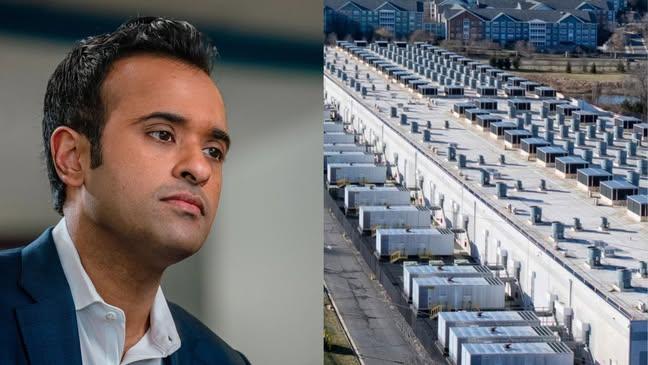
Vivek Ramaswamy’s financial holdings in companies connected to the data-center industry are drawing renewed scrutiny as the Republican candidate campaigns on a plan to reshape Ohio’s rapidly expanding data-center sector.
Financial disclosure records reviewed by the Ohio Capital Journal show that Ramaswamy holds investments connected to multiple parts of the data-center supply chain, including NVIDIA, Microsoft and Amazon, as well as other technology, semiconductor, industrial real-estate and infrastructure companies.
NVIDIA supplies chips widely used for artificial intelligence computing, while Microsoft and Amazon operate major cloud-computing businesses that depend heavily on data-center infrastructure.
Ramaswamy also has exposure to the semiconductor industry through the Strive U.S. Semiconductor ETF, a fund he helped launch. A previous federal disclosure listed an investment in the fund worth between $1 million and $5 million.
His data-center policy
The issue has become increasingly important in Ohio, where data-center construction has expanded rapidly.
In August, Ramaswamy announced an “Ohioans-First” data-center policy. Under his proposal, new facilities would have to meet conditions including providing benefits to nearby residents, protecting air and water quality, and protecting farmland. He has also proposed requiring data centers to cover their own electricity costs and preventing certain property-tax abatements.
The next Ohio governor would have significant influence over agencies involved in utilities, economic development and tax incentives, making the candidates’ personal financial interests a subject of public scrutiny.
Questions over potential conflicts
Progressive advocacy group Innovation Ohio argues that Ramaswamy’s investments could benefit financially from continued data-center development. Its analysis says his portfolio reaches across much of the industry’s supply chain.
However, the available disclosures do not establish that Ramaswamy would personally profit from every data-center project built in Ohio, nor do they show exactly how much he earns from each investment. Ohio’s financial disclosure rules do not require complete reporting of investment income. The Ohio Capital Journal reported that Ramaswamy did not respond to its request for comment on the issue.
That distinction matters as Ohio voters consider how the state’s data-center boom should be regulated.
For Ramaswamy, the question is no longer simply whether Ohio should attract more technology investment. His financial portfolio has become part of the debate over whether a future governor should personally hold investments connected to an industry that his administration could help regulate and expand.

😂 “NOT THE RETAINER HOLDER!” — Kelly Stafford’s hilarious comment summed up the unexpected detail in Brittany Mahomes’ post after the Chiefs’ commanding 30–10 win over the Broncos. Brittany celebrated Patrick’s return with a heartfelt message, but the final photo revealed another way she was supporting her husband—and fans couldn’t help laughing. Even Patrick chimed in with heart-eye emojis. ❤️ Discover the little detail behind Brittany’s unexpected postgame “assist” here. 👇👇👇

😱 ONLY TAYLOR SWIFT & HER NFL HUSBAND CAN HAVE THIS KIND OF ACCESS…👇 Taylor Swift and her NFL star husband are living a life most people can only imagine. From luxury homes in different cities to a lifestyle built around privacy and freedom,their world operates on a completely different level. 👇 The private world of Taylor Swift & her NFL husband is revealed below.

🚨🔥 HOT NEWS: TAYLOR SWIFT CAUGHT PLAYFULLY ADMIRING THE DIAMOND WEDDING RINGS FROM TRAVIS KELCE… BUT IT WAS THE LITTLE MOMENT AFTER SITTING BESIDE TOM CRUISE THAT HAD FANS MELTING OVER THEIR LOVE STORY 💍❤️

“🚨🔥 HOT NEWS: EVERYONE WAS CAPTIVATED BY TAYLOR SWIFT’S STUNNING RED PLAID DRESS… BUT FANS ARE NOW NOTICING THE SWEET LITTLE DETAIL HIDDEN IN HER LOOK, A POSSIBLE TRIBUTE CONNECTED TO TRAVIS KELCE THAT HAS MANY SEEING THEIR LOVE STORY IN A WHOLE NEW WAY ❤️💍 👇 READ THE FULL STORY BEHIND THE HEARTWARMING DETAIL THAT FANS CAN’T STOP TALKING ABOUT.”

I Fell In Love With A Man More Than Twice My Age. I Wasn’t Prepared For What Marrying Him Would Mean.

Shockwaves as Trump’s $2.8B taxpayer-funded ‘gift’ exposed: ‘My God’

Rumors Swirl Over Xi Jinping’s Health After BRICS Summit

Ramaswamy’s Data Center Investments Raise Questions as He Campaigns for Ohio Governor

Meghan Markle’s Friendly School WhatsApp Message Turns Into Privacy Scare After Her Number Is Reportedly Leaked

Trump-Appointed Fed Chair Raises Interest Rates as Inflation Stays High

Trump’s $5K Promise Runs Into a Major Polling Problem
