
NEWS
💔NFL BOMBSHELL! Jalen Hurts Reportedly Faces a Season-Ending Medical Setback After Doctors Discover Multiple Blood Clots in His Lungs! Eagles Fans Are Stunned, Philadelphia Faces Serious Questions, and Everyone Wants the Latest Update on His Recovery!

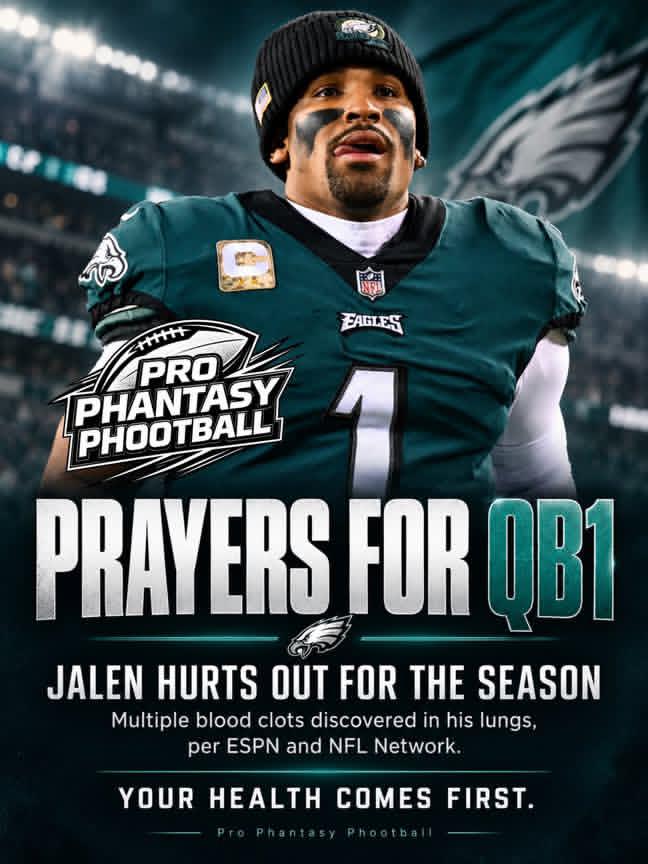
The Philadelphia Eagles have received devastating news about their star quarterback, Jalen Hurts
. Following further medical evaluations, Hurts has been diagnosed with deep vein thrombosis and bilateral pulmonary emboli, meaning blood clots have been found in both lungs. The diagnosis has forced the 28-year-old quarterback out of football activities while he undergoes treatment, raising major questions about Philadelphia’s season and his eventual return to the field.
For Eagles fans, the announcement represents a frightening development in an already difficult season. However, there is encouraging news amid the uncertainty: Hurts is reported to be clinically stable, his medical prognosis is very good, and his representatives expect him to make a full recovery.
Here is what happened, what the Eagles have confirmed, and what this could mean for the team’s future.
The situation began with what initially appeared to be a problem with Hurts’ left calf. According to the Eagles’ medical timeline, the quarterback sought treatment on October 8 after experiencing discomfort following Philadelphia’s October 4 game against the Los Angeles Rams, during which he believed he had been struck in the calf.
On October 10, medical staff performed an ultrasound in London ahead of the Eagles’ matchup against the Jacksonville Jaguars. The examination revealed a superficial blood clot in his calf.
After consulting medical specialists, the team determined that Hurts could safely play. He subsequently took the field against Jacksonville on October 11, completing 21 of 40 passes for 220 yards and one touchdown in Philadelphia’s narrow 19–17 defeat.
But the situation changed after the game.
A follow-up ultrasound on October 14 revealed movement in the clot. Philadelphia ruled Hurts out of its next game while doctors gathered additional information and determined the appropriate course of treatment. The Eagles then placed him on injured reserve on October 17.
Further medical evaluations revealed a more serious condition: deep vein thrombosis alongside bilateral pulmonary emboli. His agent, Nicole Lynn, confirmed the diagnosis in a statement released on October 19.
The most important detail in the latest announcement is that Hurts is reportedly stable and has a positive prognosis.
According to the statement issued by the Eagles and his agent, his treatment will involve anticoagulant medication, commonly known as blood thinners. While receiving this treatment, he will not be permitted to participate in contact activities, including football.
The statement also expressed confidence that he would recover fully and would be able to resume contact football activities when he is no longer taking the medication and is medically cleared.
His representatives further indicated that they do not anticipate long-term effects from the condition.
These details are important because they distinguish the immediate threat to his football career from the longer-term outlook for his health.
Blood clots in the lungs can be a serious medical condition. Anticoagulants help prevent clots from growing and new clots from forming, but the timing of a return to contact sports depends on medical assessment and the risks associated with the treatment.
The encouraging update is that Hurts’ representatives expect a full recovery. The immediate priority is his health, not a return date.
The headline that Hurts could miss the entire season is not merely speculation without a basis. On October 19, PEOPLE reported that his season was over, citing his agent’s statement and the restrictions imposed by his treatment. The Philadelphia Inquirer reported that he was out indefinitely and could miss the remainder of the 2026 season.
The distinction matters: Hurts is definitely prohibited from contact football while taking blood thinners, but the team’s official statement did not announce a specific date for his return or explicitly declare his season over.
Blood-thinning medication can increase the danger of serious bleeding during collisions, tackles and other contact activities. For a quarterback who regularly faces defensive pressure, returning before it is medically safe would pose an unacceptable risk.
The Eagles must therefore plan for his absence without rushing his recovery. Even if his symptoms remain manageable, his return will depend on medical advice and when he can safely resume contact activities.
Hurts’ absence creates an enormous challenge for Philadelphia, which is already trying to recover from a disappointing stretch of performances.
The Eagles entered their October 18 matchup against the Carolina Panthers following three consecutive defeats. They then lost 25–14, falling to a 2–4 record. Backup quarterback
Tanner McKee
started in Hurts’ place and is expected to handle the starting role for the foreseeable future.
The team also has Joe Milton III and rookie Cole Payton available at quarterback, giving the coaching staff additional options as it adjusts to the loss of its starter.
However, replacing Hurts is not simply a matter of putting another quarterback under center. His running ability, passing decisions, leadership and experience are important elements of Philadelphia’s offensive identity.
McKee will need to build chemistry with the receiving corps, make quick decisions under pressure and help the offense become more consistent. Philadelphia’s coaching staff must also determine how best to use its remaining playmakers while Hurts focuses on recovery.

❤️ TAYLOR SWIFT AND BRITTANY MAHOMES REUNITE FOR A STAR-STUDDED CHIEFS NIGHT OUT! Joined by Travis Kelce and Patrick Mahomes, the reported celebration for teammate Kenneth Walker III’s dog has fans buzzing! The WAGs’ reunion is stealing attention, and everyone wants to see who showed up and what happened! 👀🔥 CLICK FOR THE DETAILS! 👇

❤️TAYLOR SWIFT AND TRAVIS KELCE SPOTTED IN A ROMANTIC LAKE COMO GETAWAY—BUT ONE DETAIL HAS FANS STUNNED! After the Chiefs’ clash with the Chargers, the couple allegedly enjoyed a relaxed, affectionate moment in Italy. Now fans are asking the same burning question about Taylor’s appearance! 👀🔥 SEE WHAT EVERYONE IS TALKING ABOUT! 👇

🚨❤️TAYLOR SWIFT AND TRAVIS KELCE SPOTTED IN A ROMANTIC LAKE COMO GETAWAY—BUT ONE DETAIL HAS FANS STUNNED! After the Chiefs’ clash with the Chargers, the couple allegedly enjoyed a relaxed, affectionate moment in Italy. Now fans are asking the same burning question about Taylor’s appearance! 👀🔥 SEE WHAT EVERYONE IS TALKING ABOUT! 👇

🔥😱 JUSTIN BIEBER COLLAPSE CLAIM SPARKS FRESH CONCERNS! A disturbing account describes the pop star seemingly sniffing something before collapsing as he prepared to eat. Social media is buzzing with questions, but speculation is not proof—and the crucial details still need verification. READ THE FULL BREAKDOWN HERE! 🚨👇

🚨👀SASHA OBAMA SPOTTED SMOKING ON THE STREET—AND FANS ARE RAISING QUESTIONS! Barack Obama’s daughter has sparked fresh online discussion after an alleged public sighting. But beyond the viral photos, supporters are asking for compassion, privacy, and respect. What do we actually know about the moment? SEE THE DETAILS HERE! 👇

😱👑 ROYAL BOMBSHELL! CAMILLA REPORTEDLY BREAKS DOWN IN TEARS AS WORRIES GROW OVER KING CHARLES! With Reports Describing the Monarch as Being in “Agony,” Fresh Questions Surround His Wellbeing and the Emotional Toll on His Wife. The Palace Has Everyone Watching Closely! 💔 CLICK TO FIND OUT MORE! ⤵️

🚨😂 TAYLOR SWIFT AND CAITLIN CLARK JUST GAVE FANS ANOTHER VIRAL MOMENT! That Back Hug Is TOO MUCH! 😭❤️ The Internet Is Already Loving Their Playful Energy, and Fans Cannot Stop Calling Caitlin “TAYDAUGHTER”! CLICK TO SEE WHY EVERYONE IS LAUGHING AND GUSHING! ⤵️

🚨🔥 TAYLOR SWIFT AND TRAVIS KELCE TAKE OVER 1587 PRIME AFTER CHIEFS’ HUGE VICTORY! Caitlin Clark Joins the Postgame Spotlight as the Celebrity-Filled Celebration Gets Fans Talking! What Happened After Kansas City’s 22–6 Win Has Everyone Curious! 👀🏈 SEE THE PHOTOS AND DETAILS HERE! ⤵️

🚨💍 1. TAYLOR SWIFT JUST LEFT FANS STUNNED WITH ONE UNEXPECTED WEDDING-RING CHANGE! The Superstar Was Spotted Wearing Her Wedding Band All Alone, Ditching Her Usual Ring Stack—and Fans Are Zooming In on Every Detail! Is This Simply a Bold New Style Move? 👀🔥 SEE THE PHOTOS EVERYONE IS TALKING ABOUT! ⤵️

Travis Kelce Stuns Alongside Wife Taylor Swift in Romantic Video Promo for “Cleveland,” the ‘Life of a Showgirl: The Encore’ Track Dedicated to Her NFL Husband

🚨 CHIEFS EMOTIONAL MOMENT: Kansas City’s 22–6 VICTORY Over the CHARGERS Was Only Part of the Story! A reported POSTGAME NATIONAL ANTHEM PERFORMANCE delivered an UNEXPECTED, HEARTFELT MOMENT that went BEYOND FOOTBALL! 🇺🇸❤️👇
