
CELEBRITY
Germany’s Regional Elections Send a Warning to Merz as AfD Gains Ground

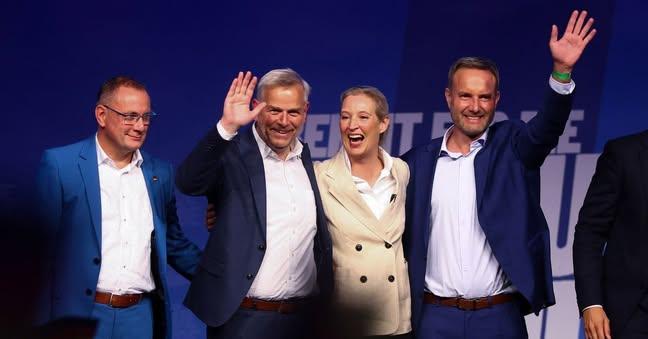
Germany’s regional elections in Mecklenburg-Western Pomerania and Berlin have delivered a significant political setback for Chancellor Friedrich Merz and his conservative CDU, while strengthening both the far-right AfD and the left-wing Die Linke.
The results are being closely watched because they highlight growing frustration over Germany’s economy, rising living costs and the difficulty mainstream parties face in building stable governing coalitions.
1. Merz and the CDU Suffer a Major Setback
The CDU experienced particularly heavy losses in Mecklenburg-Western Pomerania, recording its worst result in a state election there since 1949.
Merz described the result as a “disaster”, adding pressure on the chancellor to deliver on economic reforms and address concerns about living costs.
The result has also triggered questions within the CDU about Merz’s leadership. However, Merz has indicated that he intends to remain in office and continue pursuing his reform agenda.
The weakened position of Germany’s chancellor could also have wider implications for the European Union, given Germany’s role as the bloc’s largest economy.
2. AfD Continues to Gain Ground
The Alternative for Germany (AfD) made major gains in both states.
In Mecklenburg-Western Pomerania, the party became the strongest political force, more than doubling its result compared with the 2021 election.
The result follows another recent state election in which the AfD emerged with the largest share of votes, reinforcing its growing national presence.
The party has attracted voters with positions including tougher immigration policies, deportation of people without a legal right to remain and a push for cheaper Russian energy.
Despite its electoral gains, other major parties continue to reject governing coalitions with the AfD under Germany’s so-called “firewall” approach.
3. Forming Governments Is Becoming More Difficult
Germany’s political landscape is becoming increasingly fragmented.
With votes divided among more parties, traditional two-party governing arrangements are becoming harder to establish. In Mecklenburg-Western Pomerania, preliminary results indicate that a three-party coalition would be needed to form a government.
The AfD’s growing vote share adds another complication because mainstream parties have so far ruled out cooperation with it.
In Mecklenburg-Western Pomerania, one possible arrangement would involve the SPD working with the Greens and Die Linke. In Berlin, the Left Party could potentially work with the SPD and Greens.
Such coalitions require parties with different priorities to reach agreements on major policies.
4. Economic Anxiety Is Shaping Voter Choices
Economic concerns played an important role in the elections.
Germany has experienced years of weak economic growth, while voters continue to face pressure from living costs and uncertainty over employment.
The election campaigns also took place amid higher fuel prices linked to the conflict in the Middle East and further job cuts in German industry.
Different parties offered different responses.
In Berlin, Die Linke focused heavily on housing affordability, proposing more affordable homes and measures aimed at reducing excessive rents.
In Mecklenburg-Western Pomerania, the AfD promoted the idea of restoring Russian gas supplies through the Nord Stream pipeline, arguing that this could help reduce energy costs.
5. Voters Are Moving Away From the Political Centre
Another major theme was the movement of voters away from Germany’s traditional mainstream parties.
Die Linke recorded significant gains, particularly among voters who had previously supported the SPD and CDU.
According to preliminary polling data from infratest dimap for ARD, Die Linke gained around 28,000 voters from the CDU and 45,000 from the SPD in Mecklenburg-Western Pomerania.
In Berlin, the SPD lost roughly 36,000 voters to Die Linke, while the Greens lost around 51,000.
The movement shows how economic concerns and dissatisfaction with established parties are reshaping Germany’s political landscape.
What the Results Mean
The elections point to a more fragmented German political system, with both the AfD and Die Linke gaining support while traditional centre parties face pressure.
For Merz, the immediate challenge is to demonstrate that his government can address economic concerns while maintaining support within his own political camp.
For the AfD, the results represent another increase in electoral strength, although its ability to translate that support into governing power remains constrained by the refusal of other major parties to form coalitions with it.
The next major question is whether Germany’s mainstream parties can rebuild support while finding workable coalition agreements in an increasingly divided political environment.

Republican backlash grows over Don Jr.’s billionaire-funded Bahamas wedding celebrations

Trump’s ‘Breathtaking’ Corruption Has the World Feeling Like It’s ‘Coming Apart,’ Strategist Says

Trump warned of ‘painful attacks’ should he follow through on violent threat, report says

Germany’s Regional Elections Send a Warning to Merz as AfD Gains Ground

Leon Black Faces Congressional Contempt Over Jeffrey Epstein Investigation

Charles Spencer Stands by Claim About King Charles After Princess Diana’s Funeral

New Zealand Calls for Stronger U.S. Role in Pacific as Regional Tensions Grow

Xi Heads to Trump Summit as China’s Trade Engine Keeps Roaring

How Trump and Xi Went From Tariff War to Trade Truce

Macron Backs Canada’s Push for Closer EU Ties as Ottawa Turns Toward Europe

Red-State Voters Show Growing Frustration With Trump Ahead of Midterms
